TRUST AI @ TÜV SÜD SPECIAL COLUMN
Trust AI @ TÜV SÜD special column has been published for serval months, this series of posts aims to help Chinese AI enterprises better understanding of upcoming international supervision in advance.
The EU's Artificial Intelligence Regulation will become law in 2024, while it proposed considerably high penalties for any violation.
The regulation classifies AI into three categories, with the risk it may create: unacceptable risk AI, high risk AI, and low or minimal risk AI.
Five policy options were proposed:
Option 1: EU voluntary labelling scheme; (Voluntary labelling for all AI)
Option 2: Ad-hoc sectoral approach; (Different AI regulations for each high-risk sector)
Option 3: Horizontal risk-based act on AI; (Unified AI regulation for all high-risk AI)
Option 3+: Horizontal risk-based act on AI + codes of conduct; (Unified AI regulation for all high-risk AI, and codes of conduct by industry associations and other representative organisations)
Option 4: Horizontal act for all AI. (Unified AI regulation for all AI, irrespective of the risk)
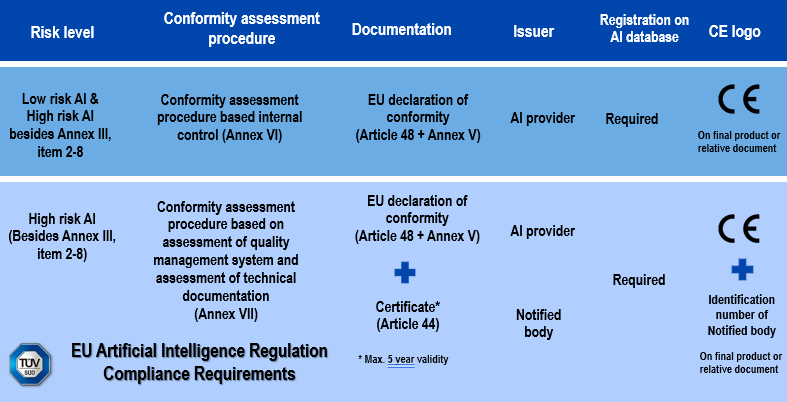
For high-risk AI systems besides the list of points 2 to 8 of Annex III, providers shall choose a notified body for certification, and follow the conformity assessment procedure based on the assessment of the quality management system and assessment of technical documentation (Annex VII).
This conformity assessment mainly includes the quality management system, the control of the technical documentation, and the surveillance of the approved quality management system.